
One of the most fundamental barometers of cellular health is called the “membrane potential.” Both the outer cell membrane and the mitochondrial membrane should have an electrical charge differential across them. At the most basic level, a charge differential simply means there are more electrons (or protons) on one side of the membrane than on the other.
Many chronic diseases such as Parkinson’s disease and cancer have a well-documented loss of the membrane potential. Loss of this potential has a number of detrimental impacts on cellular function, not the least of which is that the mitochondria lose their ability to efficiently produce ATP (i.e. the energy currency of the cell) and to quench free radicals that are created continuously.
The earth has an inherent negative charge relative to the atmosphere. Living organisms continuously regulate their cellular electrical charge by exchanging electrons through direct contact with the earth.
Shoes with rubber soles first came into use in the early 1800s and were the standard for manufactured shoes by the end of that century. An unforeseen consequence of this, though, has been the loss of the electrical connection we have to the earth due to the insulating properties of rubber. Everyone in the developed world went from being in contact with the earth throughout the day, to little or no direct contact with the earth, often for days, weeks, or even months at a time.
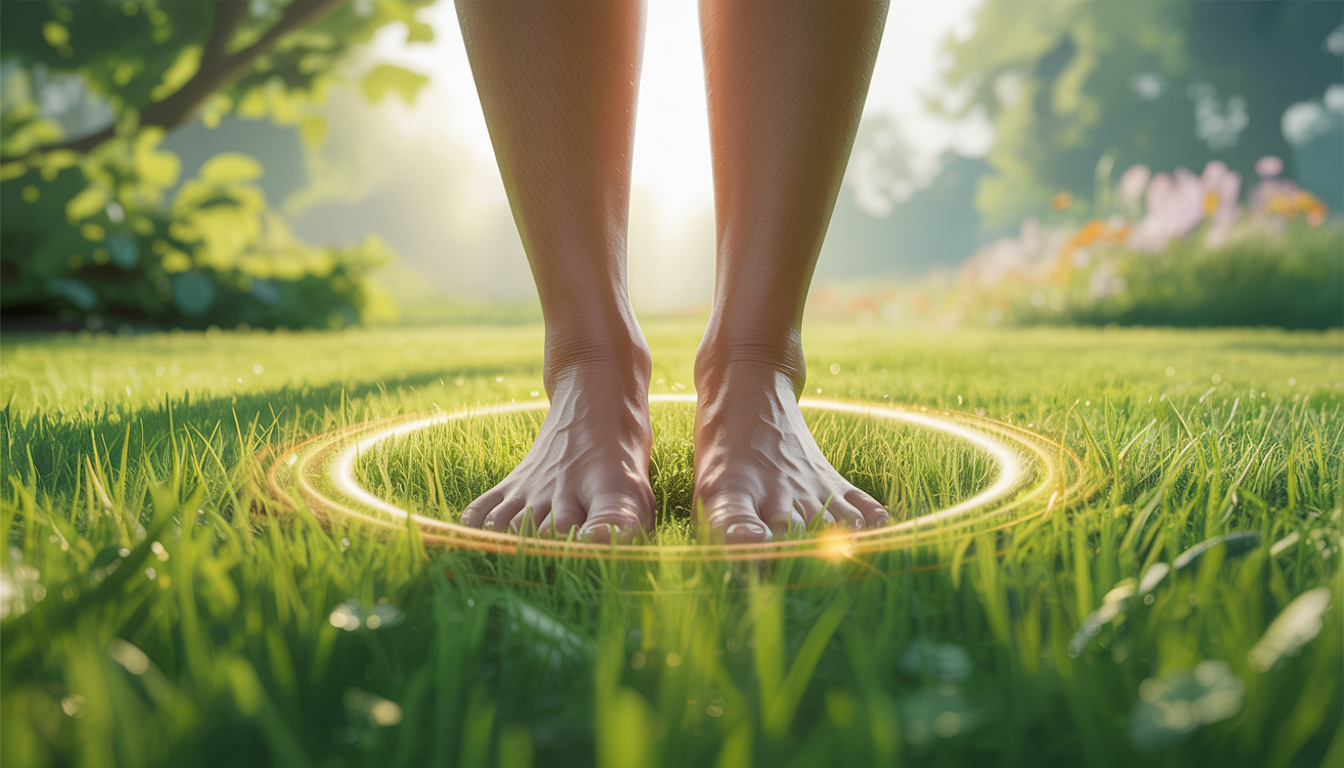
Grounding, also called Earthing, is a therapy that’s as simple as you might imagine: put your bare feet on the earth daily. One study showed that mitochondrial energy production increased by up to 11% within a single 60-minute grounding session. Most studies have subjects in contact with the earth for 30 to 60 minutes daily, and most studies span 8-12 weeks, though some studies document beneficial physiological changes after a single grounding session. Documented benefits include improved sleep and pain reduction, improved autonomic nervous system regulation, blood pressure reduction, reduced inflammation, improved wound healing, and many others.
When recommending this therapy to patients I am commonly asked if standing on concrete or wood, such as on a deck, might work. The answer is that it might, though would be less efficient at conducting electrons than standing directly on grass, dirt, or sand. And just to state the obvious, it doesn’t work to put dirt or sand in a box, bring that inside, and put your feet in it. The point is that the dirt you stand in is directly connected to the whole great big earth.
Another option, for people without easy access to dirt, is to purchase a grounding mat, grounding bedsheets, or other grounding appliances. These are made with an interwoven metal mesh and it literally plugs into the grounding plug in a three-pronged outlet in the wall. The key is to test to be sure the grounding plug is a true ground. A device such as this will tell you. Studies on grounding might only last up to 12 weeks, but there is no reason not to engage in grounding every day of the year. For many, in the winter months, it becomes a form of hydrotherapy as well. That has yet another big set of benefits, but I’ll save that story for perhaps another newsletter.


