
Oxygen, Nanobubbles, and Lung Health
There’s something I have found curious and you can experience it for yourself with a quick experiment:
Take a deep breath and hold it. Hold it as long as you feel like you can hold it without causing any panic for yourself. Then, instead of pushing the air out quickly and breathing in to get more air, let the air out slowly and even swallowing a time or two as you are exhaling.
When I do this, at the moment I start exhaling I am feeling like I’m at the very end of how long I can maintain without breathing in. But as I slowly breath out – and for some reason especially when I swallow a time or two as I’m breathing out – it extends how long I can last without breathing back in. Often, once I’ve breathed all the way out, I can hold my breath out for another 5-10 seconds before I need to breath in again. So, when I first started breathing out I was at my limit of holding my breath; upon slowly breathing out I somehow extend how long I can wait until I need to breathe in again. Why would breathing out relieve my urgent need to breath in?
A Quick Detour Into Lung Physiology
We all know lungs take in oxygen. What happens after you breathe in, though, is fascinating in the details. The standard story is that the oxygen diffuses through the lung lining, it gets taken up by red blood cells in the adjacent capillaries, then those cells carry the oxygen to all the cells of the body. However, there is an important intermediary along that path, the first one encountered by the incoming oxygen: surfactant.
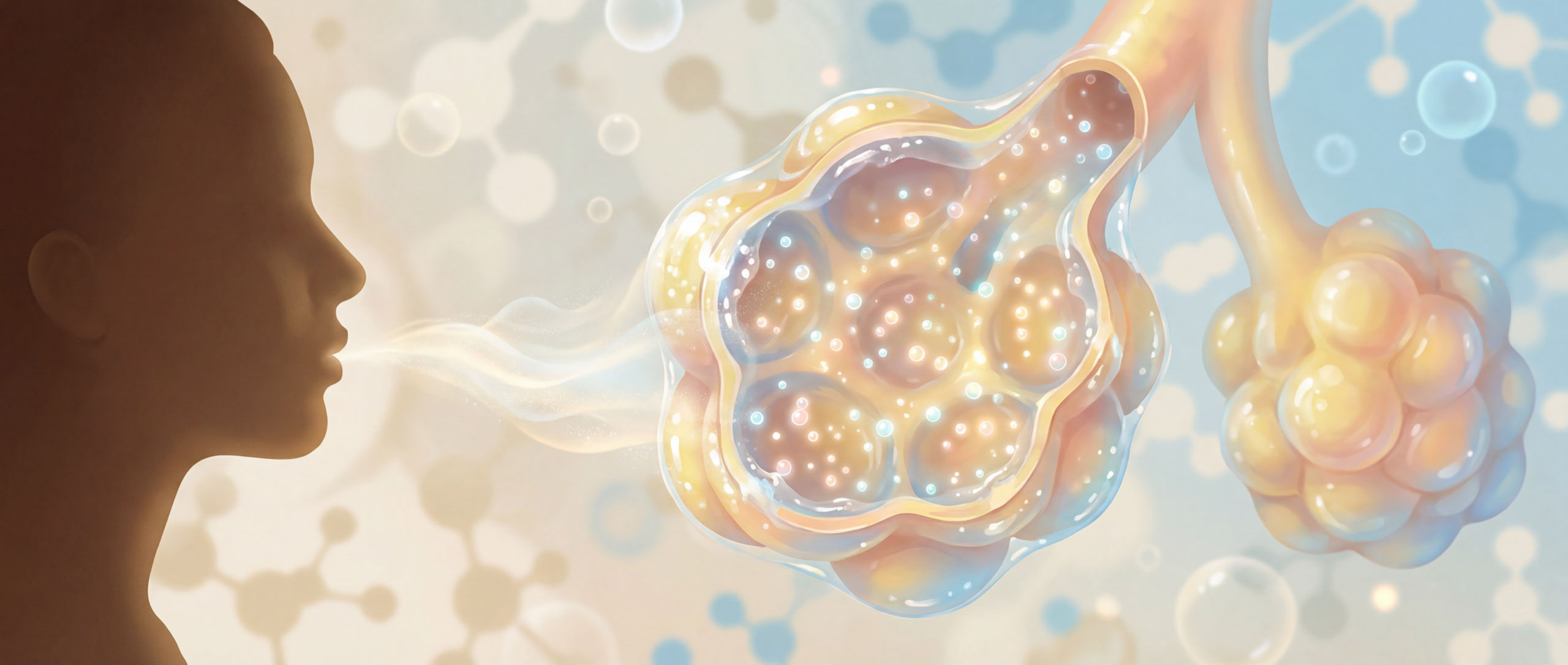
Surfactant is a complex, extremely thin liquid layer in healthy lungs, a layer that maintains a specific 3-dimensional structure. That structure is optimized for extremely small bubbles of oxygen and nitrogen, called nanobubbles, to be stored and transported. Surfactant is produced by the cells that make up the inner lining of the lungs. It is composed of fats and proteins. Those molecules, and especially the fats, are typically sulfated, which allows surfactant to do what it is supposed to do. And what it does is keep us alive, moment to moment.
The presence of surfactant is what makes it possible for our lungs to expand and take in air/oxygen. Premature infants often are unable to breath on their own initially and that is due to an inadequate amount of surfactant in their undeveloped lungs. Cystic fibrosis is caused by a genetic glitch in a gene/enzyme involved in surfactant production altering its composition, which leads to ongoing respiratory infections, compromised breathing, and other problems.
Surfactant lines the inside of the air-filled sacs in the lungs, called alveoli. Oxygen molecules have to diffuse through that layer before entering the blood. How thick is that layer of surfactant? It is around 200nm thick. For comparison, an average human hair is about 400 times thicker than that! But how thick is 200nm relative to the ‘thickness’ (the diameter) of an oxygen molecule? I was shocked to learn that 200nm is over 550 times thicker than the width of an oxygen molecule!
I looked all this up because I was trying to understand how far an oxygen molecule has to travel to get from the inside of the lung sac and into the blood.
To give an analogy, consider a standard-sized 10-speed bicycle (each tire representing one oxygen atom in the oxygen molecule, O2). If the oxygen molecule were the size of a 10-speed bike, I would have to ride that bike over half a mile to go a distance analogous to that traveled by oxygen through the surfactant layer. How could it be, I wondered, that when I breathe in my feeling of air hunger can go away almost instantly if oxygen molecules have to cross through a relatively giant pond of surfactant first? And why would it be that breathing out could postpone my need to breathe in when holding my breath?
Nanobubbles to the Rescue
It was a conversation with a colleague of mine, Dr. Petra Davelaar, that sent me down the rabbit hole of nanobubbles. These are the tiniest bubbles you can imagine, bubbles containing both nitrogen and oxygen gases, bubbles that are dissolved into the surfactant layer. These bubbles explain why it is that I get immediate relief upon breathing in after holding my breath, and also why breathing out can prolong my need to breath in after holding my breath to the max. Hang with me, I will get to some ideas for therapies to optimize lung health.
Oxygen doesn’t have to traverse that 0.6 miles (relatively speaking) to get from the lungs to the blood. Surfactant is saturated with nanobubbles containing oxygen. Breathing in brings more oxygen into the lungs, but it is the expansion/contraction of the lungs that acts like squeezing a sponge. As the lungs change shape the nanobubbles, which saturate the surfactant, are pushed away from the alveoli and toward the blood, like water at the back of the garden hose pushing out water at the front of the hose.
Therapies
What does this mean for therapies to enhance lung health? A few things. First, the elasticity of the lungs is essential to keep driving the piston that pumps the oxygen into our blood. Second, the healthy composition of surfactant is essential to maintaining an environment hospitable to those nanobubbles.
Whether it’s your neck, your hamstrings, or your lungs, stretching is a way to maintain flexibility. How do you stretch your lungs? You breathe in deeply, then gulp air one or two or five times to push it beyond your breathe-in capacity. Don’t do it to the point of being painful or even uncomfortable, and maybe initially a single extra gulp is all that is comfortable. You just want a gentle stretch. Hold your breath until it is feeling like, yep, it’s time to breath in. Don’t go to the point of panic or desperation but you should feel a mild urgency about the need for air.
When you breathe out, resist the temptation to blow air out rapidly so you can take another breath. Instead, try to breathe out slowly so that the exhale takes perhaps 5 or even more seconds. When I do this, for some reason if I pause to swallow as I’m exhaling it reduces my air hunger a quick moment. Once you have exhaled completely, try to force even more air out by contracting your abdomen and chest/pectoralis muscles to whatever extent that is comfortable. The goal is to “wring out” the sponge as completely as possible. Now fully exhaled, see if you can pause for even a few additional seconds more before breathing in again.
You have just fully expanded, then fully contracted, that surfactant sponge lining your lungs. I hope you also got the first-hand experience of breathing out satisfying your immediate oxygen need after holding your breath. It’s a pretty cheap therapy to practice. A few times daily seems prudent to me.
Another way to support surfactant health is by obtaining an adequate supply of the factors and cofactors involved in its composition and maintenance.
Choline
Surfactant is composed primarily of lipids, and about 80% of those lipids are built from choline. Studies have shown that choline supplementation can enhance surfactant production. There are four important caveats to point out about choline and its supplementation. First, vegetarian – and especially vegan – diets are inherently low in choline, so I think it is a nutrient worth supplementing in that context.
Second, through my own research into choline metabolism I have come to appreciate how important it is for any supplemental choline to be derived from natural sources, not chemically synthesized. This is because naturally-sourced choline will be depleted in deuterium.
Third, those choline-derived lipids in surfactant are sulfated. Therefore, it stands to reason that people with impaired sulfur metabolism – which directly impacts sulfate production – could have some degree of compromised lung function as a result of their sulfur-metabolism issues. Note: I have no evidence that this is the case, I’m just connecting some dots that seem reasonable to connect. I have had many patients with sulfur issues over the years who report to me a chronic feeling of air hunger or an inability to take a full breath of air. Just saying.
Finally, the 3-D structure of surfactant is permeated with water channels. The water in those channels is structured, and the structuring happens in response to the negative charge on surfactant imparted mostly by the presence of sulfate molecules. It again stands to reason that the more deuterium depleted the water moving through those channels is, the more efficiently the surfactant and associated alveolar cells will carry out their functions. It is another case to be made for drinking deuterium-depleted water and/or eating a deuterium-depleted diet.
Biotin, Magnesium, and Inositol
These are three more important factors/cofactors for the healthy and adequate production of surfactant. All can be obtained in the diet or through supplementation. Again, I believe it is very important that supplemental inositol be derived from purely non-synthetic sources, which in fact have only recently become available retail.
Summary
My fascination with surfactant, its composition and structure, and related therapies is relatively new for me. It has been an eye-opening deep dive into the research, research which is still in its early stages. If you’d like to learn about some other therapies I believe can enhance the health of surfactant and potentially improve your respiratory capacity, schedule a conversation with me by visiting https://gregnigh.com/schedule, emailing drnigh_info@gregnigh.com, or calling 503-719-4806.


