
I have written and spoken extensively about the importance of “deuterium management” for maintaining optimal health. Deuterium, for those new to the topic, is a non-radioactive isotope of hydrogen. It is scattered throughout the universe and can be found here on earth anywhere you might find hydrogen, namely in our food and our water.
To manage deuterium means, at the most general level, lowering the deuterium content of the body while simultaneously enhancing the storage of the deuterium that remains. In the process of conducting research needed to co-author several articles on this topic (which you can read here and here and here and here), I learned a great deal about several different aspects of how bodies go about removing much excess deuterium and managing the storage of the deuterium that’s left behind.
The most recent article related to this topic was recently completed and has been submitted for final peer review. I expect it to be published soon and I’ll link to it in the April newsletter. With my research time freed up it has allowed me to go back and read through these publications, pulling out the clinically important pearls that had been nearly obscured by the dense fog of geeky details that make up the bulk of these papers.
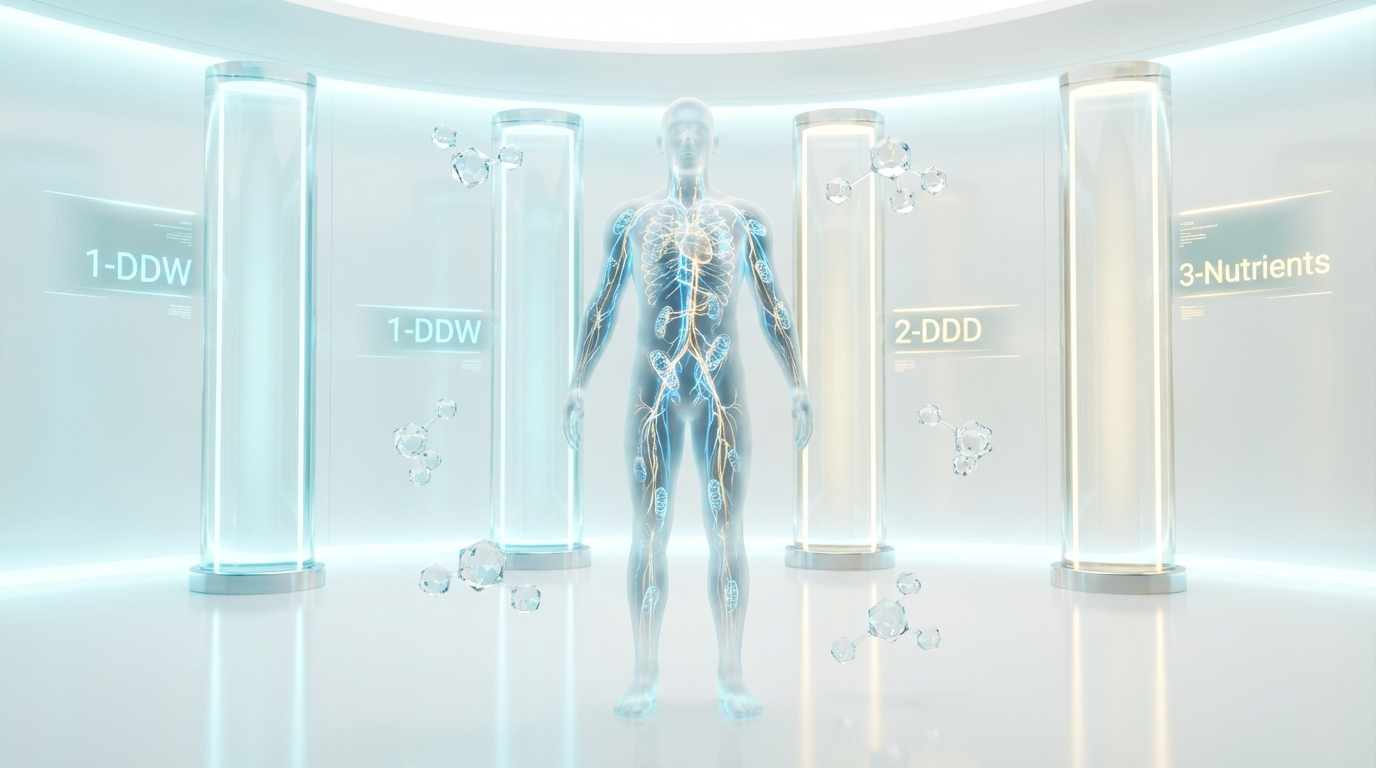
There are three pillars to this program, each pillar playing a unique and important role in deuterium management. To adopt any one of the three pillars as a therapy will be beneficial. To the best of my knowledge this is the first time these three have been brought together into one program. I feel confident in saying so because one of these pillars has only been discovered through the process of researching and writing the four articles on the topic I linked above. You are reading about it – right here – for the first time it has ever been presented as a coherent and comprehensive wellness program.
Pillar One: Drinking Deuterium Depleted Water (DDW)
Mitochondria are the structures within cells that ultimately consume oxygen and, in the process, generate the energy that powers cellular activities. Though it is a significant over-simplification, think of there being two compartments of water in the body: water outside the mitochondria, and water inside the mitochondria.
When you drink DDW consistently over time it replaces the water in your body outside the mitochondria – water that is currently relatively high in deuterium content – with water that is low in deuterium content. Reducing the deuterium content in that compartment of water – which is most of the body’s water – allows virtually all cellular functions outside the mitochondria to operate more efficiently. This is enormously important for health restoration and maintenance, because the more deuterium that’s around, the greater the risk that it will “clog up” various metabolic pathways.
Lowering deuterium in the body too quickly or too dramatically can actually cause cellular stress. I will coach anyone who goes through this 6-week program on which concentration of DDW to drink and how much to drink daily.
Pillar Two: Eating a Deuterium-Depleted Diet (DDD)
As mentioned above, the water you drink fills the space outside the mitochondria. The food you eat is bringing deuterium into your body as well. Those deuterium atoms in food have the greatest risk of making their way inside the mitochondria. When deuterium is present inside mitochondria it causes two very significant problems: first, it can literally shut down the “pump” that generates energy for the cell. Second, if it combines with incoming oxygen it will generate water inside the mitochondria that is not deuterium depleted. This causes a cascade of additional problems for energy production and also for the building of organic molecules that happens in that space as well.
This program involves eating a DDD for the duration of the 6 weeks of the program. I provide guidelines for eating a DDD and even a 2-week meal plan with two meals daily for those who like to have specific ideas of what to put on the plate. The DDD is generally a high-fat/low-carb diet, similar to but not entirely the same as a ketogenic diet.
Note that it is not really possible to eat a vegan diet that is significantly depleted in deuterium because carbohydrates (grains, fruit, and legumes) are naturally much higher in in deuterium content than fats. The same is true, though to a lesser extent, regarding a vegetarian diet.
Pillar Three: Deuterium-Clearing Nutrients
This is the category that has remained unknown until our recent research and publications. When deuterium is “scrubbed” from incoming organic molecules to prevent their use in any metabolic processes, they have to be “trapped” so they don’t engage in reactions and so can be excreted. We identified several endogenous organic molecules (i.e. molecules made in the body through normal metabolic processes) that perform this function. Many of these were previously thought to be either waste products or to have little biological function.
In addition to those endogenously produced deuterium traps, we identified several nutrients with molecular structures that perform the same function. When consumed in the diet or as nutritional supplements, these nutrients can pick up and hold tightly to ambient deuterium. One very interesting finding was that, while these nutrients can play many important metabolic roles in the body, once one of them picks up a deuterium atom and locks it within its molecular structure (this most commonly happens in the gut), all other activity for that molecule ceases. It becomes metabolically inactive and is excreted through the bowel.
As the third pillar of this program I outline and orient patients to these key deuterium-clearing nutrients, paying special attention to everything from how they are manufactured to the timing of dosing to optimize their deuterium-clearing capacity.
I think that optimizing deuterium management in the body is one of the most – and perhaps the most – foundational things any of us can do to promote health and vitality. I also recognize that I have many patients with various food sensitivities and reactivity that would require very significant modifications to the general program, and for many it might not be feasible at all.
I have only recently brought these three pillars together into a single wellness program. It is built upon solid research and I suspect, over time as I write more about it and have more and more patients going through the program, it will be picked up, modified a bit, and promoted by other practitioners in the social media space. If you’d like to be among the first to learn the details of this program and implement it for yourself, perhaps as a great way to head into Spring, schedule a consult with me: https://gregnigh.com/schedule, drnigh_info@gregnigh.com, or 503-719-4806.


