September 2026 · Newsletter
Optimizing Your Workout Time: The P.A.C.E. Program
A practical way to train your cardiovascular system to meet demand—and return to rest—more efficiently.
I remember back in the late 1970s first hearing about a runner, Jim Fixx. Jim had almost single-handedly launched the jogging craze with the publication of his book The Complete Book of Running in 1977. He would certainly have been considered to possess better-than-average cardiovascular fitness, judging by his routine of running ten miles daily, seven days per week.
And one day in the early 1980s, while out for a run, Jim had a heart attack and died. News stories at the time blamed his previous history of being overweight and smoking, which no doubt didn’t work in his favor. But that explanation, common in similar cases like this, has never seemed complete to me. It takes a very high level of cardiovascular conditioning for the heart to distribute blood throughout a body that is consistently running seventy miles each week. There had to be, I thought, differences in the types of conditioning that can happen.
In 2010, cardiologist Dr. Al Sears published PACE: The 12-Minute Fitness Revolution. “PACE” stands for Progressively Accelerating Cardiopulmonary Exertion. The rationale behind the program he described for optimizing cardiovascular fitness made complete sense to me. I created a home exercise routine for myself based upon the PACE principles and have persisted with that routine almost daily for over 20 years. I’ll summarize the core elements for you here.
Train both exertion and recovery
The central point of the PACE program is to train your cardiovascular system to rapidly adjust to meet high demand. Just as importantly, though, it is also to train your system to rapidly return to a baseline or resting state once that demand is no longer present. This is accomplished by going through cycles of higher intensity and rest during each workout session.
How high should the intensity be? That is based entirely on your capacity. It should be an intensity at which you could still carry on a conversation, but would not be able to sing a song. Maintain that level until it feels like you are at your limit—the point at which you are winded and need to rest. This might be three minutes after you started, or it might be 30 seconds after you started. The time doesn’t matter. The only gauge is your capacity. And don’t worry, that will change more quickly than you might think.
To take a break simply means dropping the intensity to very near zero. How long does the break last? However long it takes you to recover, catch your breath, let your heart rate slow down, and feel like you can do another interval. This continues through enough cycles so that your total exertion time lands somewhere between 12 minutes when getting started and 20 minutes once conditioned.
My exercise-bike routine
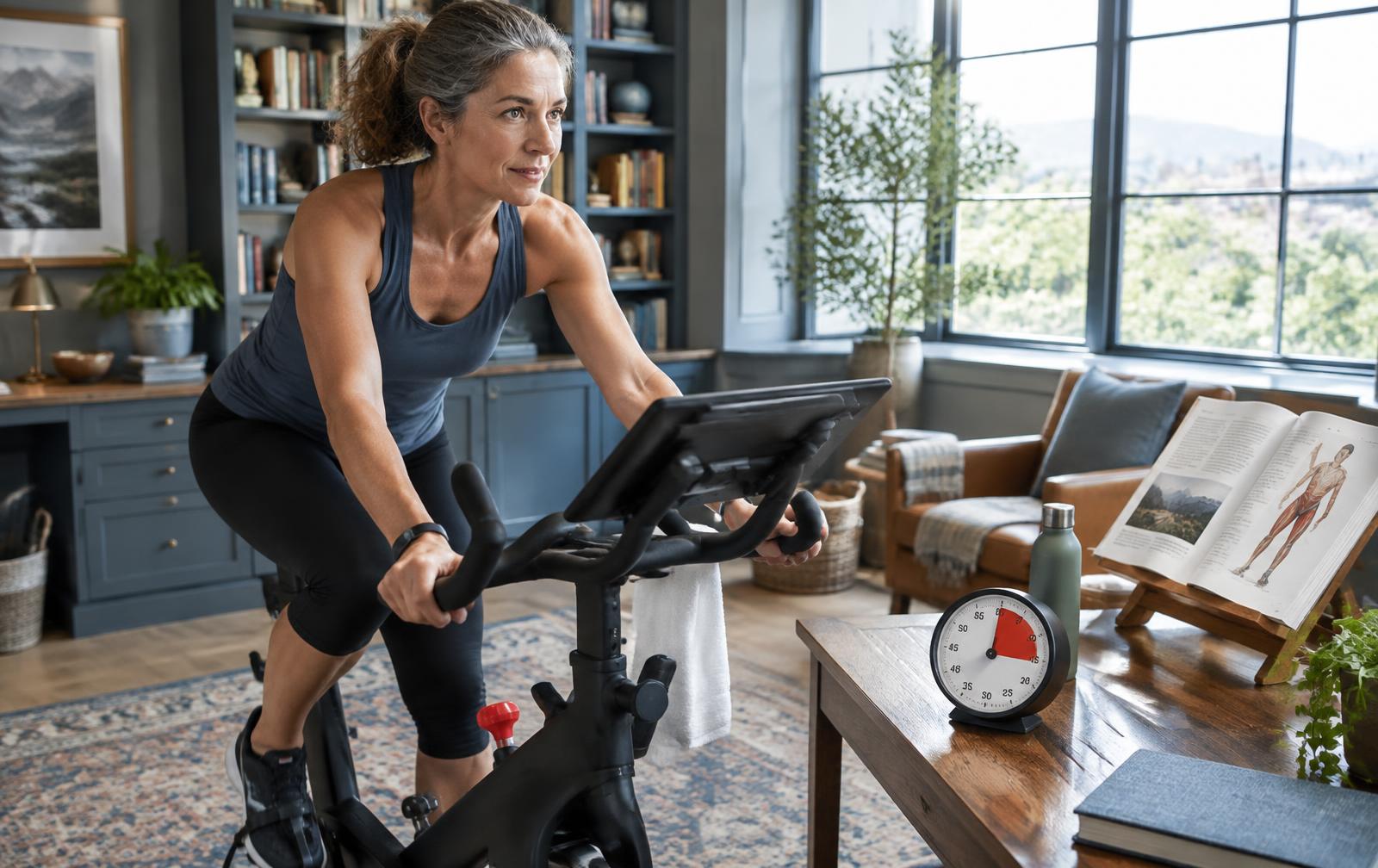
What kind of exertion is best to do? It doesn’t matter; it just needs to be something that will get you winded to the point I described above. Personally, I do these cycles on an exercise bike. For two minutes I just pedal with resistance at nearly zero, letting my muscles start moving a bit. When the timer reaches two minutes, I crank up the tension and pedal for four minutes. Then I drop the tension back to zero again.
When I first started, my exertion sessions were only two minutes before I stopped, and my recovery time was four minutes. I remember being surprised by how quickly I was able to increase my exertion times and decrease my resting time. Now, after my two-minute warmup, I exert for four minutes through five interval sessions, with a two-minute break between each one. By the end, I’ve exerted for a total of twenty minutes and my entire session has lasted thirty minutes.
While on the bike, I’m reading or watching educational videos— enjoyable activities that keep me looking forward to getting on the bike each day.
Choose an activity you can regulate
If you don’t have an exercise bike, how else might you do your exertion sessions? Walk/run intervals, jumping-jack intervals, elliptical intervals, stair-climbing intervals, and so on. It can be any activity whose intensity you can regulate, such that you can cycle between exertion to the point of feeling winded, hold it there for however long is comfortable, then rest until you feel recovered enough to do it again.
The PACE program trains the cardiovascular system to ramp up capacity quickly, and to drop back down to resting quickly as well.
There is more to the PACE program than I have described here, but this is enough to get anyone started on the core component: the progressive exertion. If you want to learn more about how to expand this into a more comprehensive program, and how to eat and supplement to optimize muscle mass and endurance, take 10% off your next scheduled visit with me. Just write “PACE” in the appointment message box, or tell Lisa you read this if you schedule through her by emailing drnigh_info@gregnigh.com or calling 503-719-4806. You can also schedule online. Patients in Rhode Island can schedule with me through rhodeislandnaturopathic.com.
Share this article
- Cardiovascular
Related topics from Dr. Nigh
- August 2026The LDL Cholesterol Con GameWhy oxidized LDL — not total LDL — is what actually matters for heart disease.
- May 2026ApoB: A Major Cardiovascular Risk Marker Everyone Over 40 Should KnowApoB reveals broader cardiovascular risk than LDL alone. Learn why people over 40—or with family history—should test it regularly.
- May 2025Need a New Disease to Generate More Profits? Just Move the GoalpostsMany diseases in the US are not actually defined by symptoms we experience, but by values determined through testing. It is obvious, once you think about it for a moment, that if you narrow the “normal” range on the test, then more people will fall outside that normal range and thus will be a candidate for treatment. And, shocking to exactly no one, that treatment will likely bring billions of dollars of additional revenue into the medical machine. First, consider osteoporosis. With a strong tendency to be diagnosed in women over the age of 50, about 1 million women are diagnosed with osteoporosis annually in the US, and another 2-3 million diagnosed with more mild bone density loss called osteopenia. And how is this diagnosed and treated?
- September 2026Glucosepane: One of the Most Important Molecules You’ve Never Heard OfHow glucosepane may connect carbohydrate intake, deuterium management, collagen stiffness, and connective-tissue health.
Discussion
Comments are moderated. Your email address will never be shown publicly.
Loading comments…